Showing posts with label Marc Suckling. Show all posts

Wednesday, 5 December 2012

Evaluation Task 3 Planning/Script


  • Whole music video
  • Ancillary tasks downloaded onto a phone
  • Talk about pitch feedback
  • Talk about rough-cut feedback from Holly
  • Feedback on final video from classmates
  • Record on Wednesday
Unfortunately, it did rain during our shoot in town. This meant we did not have time to rearrange the location of the filming. 

Luckily the rain soon stopped so we were able to continue unabated. 

Our narrative remained essentially unchanged. The only thing that differs is the lack of a girlfriend or argument as we instead opted to only utilise the singer for this narrative section. 
This was mainly because we felt the inclusion of this narrative thread would feel tired, trite and cliched.

We conformed to genre conventions of indie rock as originally planned. The only thing that might be conceived as uncharacteristic is our ancillary texts as we have used a brighter colour scheme for these products compared to current artists.

When it came to the drama studio, we decided to use the music studio instead. Unfortunately this has bright green walls, so the use of desaturation during the editing process manages to hide this fact as well as stick to genre conventions.

Well, firstly we have used a house for a setting in our music video. Secondly we stuck to our original idea and interpretation of the song which we believe ended up in a successful video.

Our teacher Holly watched our rough-cut and gave us feedback on what we've done so far and what she feels could be added to the video to improve it. One of the first things she picked up on was the good performance of the band members and particularly Michael's role as the lead singer & guitarist. 
Holly also said we need to be aware that we'll need to keep up the pace of our cuts and editing, especially our edits on the beat. Because of this advice we were conscious to maintain the same speed of editing.
After other suggestions from Holly we also implemented more cutaways to Michael walking in the streets and the use of split-screen in our video.

After we finished our music video and ancillary products and uploaded them to the blog we received feedback on them from our classmates and peers.
For the ancillary products there were comments that were raised multiple times, either positive or negative.
A positive point that was brought up by all of the groups was the good use of colour and effects in our poster and digipak. The posterization we used on the band members was a popular effect we used so we're pleased with this feedback.
Other positive feedback included that it represented the artist and genre effectively, the information was clearly visible and that the magazine advert and digipak were closely linked and there was an obvious theme.
Unfortunately we also received negative feedback for these ancillary texts. Though thankfully this was minimal, as the only negatives were the lack of "extra" information on the magazine advert and that the back panels of the digipak were too plain.
When it came to the magazine advert we were fine with this negative feedback as we purposefully neglected to include any reviews or quotes about the digipak. We did this to maintain our minimalist theme of our products and we felt that it also fitted with our genre conventions.
With the negative feedback about the digipak, we believe this to be fair, but are also adamant about the reasons we did this. The spaces with only our background pattern are where we're putting the DVD and CD so we decided that we should keep this area clear because it'd be wasted time and effort for something the consumer will not be looking at.

With the feedback on our music video, again it was mostly positive from our classmates. They almost unanimously agreed that our video used a wide variety of shot types, was well edited and fitted with our genre's conventions. The only negatives we received is that they felt we should have included more shots of Michael walking down a certain street because they felt it was effective.
We agree that this was an effective shot but we used it to it's capacity for the video, and because it is a narrative video we can only include it in sequence.

Saturday, 1 December 2012

Thursday, 29 November 2012

Final Ancillary Texts

Music Magazine Advert template
This is our final version of our magazine advert. We have put all needed information on this advert. The audience will know who's releasing the digipak, what the digipak is called, when it'll be released and where they can buy it. We have also included information on how to contact the artist.


digipack_2
digipack_1

Monday, 26 November 2012

Final Music Video Feedback

DSCN1916

We received feedback for our final music video from all the groups in our class. When all feedback was reviewed, we spotted a number of things:
  • The music video definitely has appropriate content
  • Mise-en-scene has been payed close attention, as there were use of costumes and different lighting techniques
  • There was controlled use of the camera
  •  A lot of different camera angles were used
  • The editing was effective of creating a linear meaning
  • There were a few effects and transitions included in the video
  • The editing worked perfectly with the pace of the song
  • Lip syncing was effective
  • Apparently the star persona is not clear
  • Overall, the music video was well executed
Taking this feedback into account, we believe the music video we creating is outstanding. One thing we should improve on in the future is making the star persona more clear to the audience.

Thursday, 8 November 2012

Digipak Ideas

After experimenting with using posterization in photoshop, we have agreed that this can create an interesting and effective cover.
We have discussed using all 3 members of the band on different sides of the Digipak, with Michael, the lead singer in our video, being on the cover.
Using this we can create a continuous feel for the digipak. Saying this though, we do feel that while minimalism is a genre convention of indie rock album covers, using just posterized faces like in our previous post may be too simplistic/minimal. 
To combat this we are thinking of inserting a continuous pattern into the back ground. An example of this would be from the band Kid, You'll Move Mountains, who in both their advert for their album "Loomings" use an interesting pattern.

Here, in the advert for the album, it is used to create a wave like effect, which we like. We are thinking about using this kind of pattern, or one very similar, to give a more interesting and diverse look to our cover while maintaining an indie rock and minimalistic feel.


In the album cover, the same pattern is used to a different effect, rather than creating a wave-like effect, it acts more as a background pattern to break the monotony of the image.


Digipak Test Posterizing

Here we have an image we posterized manually of popular musician Neil Fallon of Clutch.
We have done this so we can assess the effectiveness of using posterized images for our digipak and/or magazine advert.

Here is the original picture for reference:


And this is the version we posterized, and we believe that this technique can be used effectively for our Digipak if done well:


Monday, 5 November 2012

Rough Cut Feedback

Some feedback we have received:

  • Good performance
  • must keep up with pace of edits
  • Reduce length of clip thats sped up
  • More cut aways when Michael is in the street
  • Try split screen?
  • Remain focussed on lead but show more of band members
  • Ensure there is a conclusion

Sunday, 4 November 2012

Rough Cut Feedback

I have asked 3 people on their opinions on our rough cut music video, asking them what they thought about the video, whether it fit the genre of indie rock and if there were any improvements they thought we should make.

Person 1: The video is good, I like the variation in location and that there are lots of different camera angles. One improvement would be to put a few more cuts in to match the beat more.

Person 2: Liking the general feel to the video, you matched the genre to the video very well! I think that everything you have done so far is good, just make sure the rest of the video matches it.

Person 3:  More cuts are needed, the beat is faster than the pace of the cutting. But apart from that its really good!

My overall impression from the 3 people I asked is that we need to add some more cuts into the video to match the beat of the song more, but apart from that they seemed alright with what we have done so far. I have taken positives from the responses and they seemed to enjoy the video when they were watching it as well.

OKGo Music Video Analysis

OKGo have a different star persona to most other artists, the members of the band feature prominently throughout all of their videos however the audience would mostly be distracted by the things going on around them. They make their music videos very original, creating ideas that have never been done before in music video and this makes their star persona focus on the creativeness included in the video and not necessarily the music itself or the band members. An example is in the music video 'This Too Shall Pass' which is a one take music video of a domino effect chain of events which would keep the audience interested.


Goodwins theory is prominent in their music videos, especially music/visuals as there is a large amound of editing on the beat, one music video I watched called 'End Love' used editing on the beat very well and is a well shot music video. Genre characteristics are thrown out the window in the video, with them being a alternative rock group the videos don't represent this at all. The need to sell artist is a Goodwin point included, as the band members are included throughout the whole video, its just that other things distract your attention. Apart from those two points the other Goodwins points aren't really referenced, which shows they are rebelling against the norm and trying to do somthing different.


The target audience for OKGo is anyone really, they can appeal to all ages through their fun and interesting approach to their music videos. As they are dominantly a alternative rock band, it shows they are trying to appeal to a different target audience, probably still teenagers and young adults but people in that age range that prefer maybe mainstream pop or other genres. Through the modern technology use and wide range of different editing techniques used, like the way they have sped up the video 'End Love', this has been achieved by them sufficiently. This helps them to appeal to an alternative audience, and also they do this by making their videos more mass market and so they extend their audience wider than what would be expected, incorporating all different ages and different people to create a more diversified fan base.

For our music video, we are going for a target audience within the genre of indie rock, which is teenagers and young adults like for OKGo. We are appealing to them through adhering to the genre characteristics that indie rock videos carry, with there being narrative and performance sections to the video, and also through our plans for the digipak and magazine advert, in researching what other bands and groups have done, like including mainly either the band or a drawing on the covers.

Music Video Exhibition On The TV and Internet

There are many places that exhibit music videos both on and off the web, there are TV channels which exhibit music videos, the main 2 channels being VIVA and MTV. Both of the channels exhibit music videos however they mostly only show Top 40 videos rather than just music videos in general. MTV used to show music videos in general but they have since removed the 'Music Television' part of the logo as they mostly show general TV shows rather than just music videos. Whilst VIVA only cover the Top 40 chart and shows TV shows and cartoons other than this. This means that our music video would have to be popular to get on these channels and even then it would have to be popular for a period of time to have any decent exposure to the general public. They would have to exhibit our music video if it went into the Top 40 otherwise they would get complaints.


There are also internet channels that exhinit music videos, one of which is MUZU. This music channel is based purely on the internet and exhibits not only the Top 40 but has music videos in general up for viewing. For our music video to be exhibited on this website it would have to be mildly popular, as they exhibit quite a lot of music which isn't necessarily mainstream but still has a following enough to make it popular enough to be put on there. Another music video channel on the internet is Youtube. Although it has anything and everything on it, there are a large collection of music videos also included. We would be able to put the video on ourselves and build up a following that way, and if the music video got popular it would mostly probably pop up on VEVO which show all the mainstream music videos on their Youtube channel, which would increase exposure greatly.


Social Media Consumption Of Music Videos


One Night Only are on Twitter and Facebook, and they use both of these social networking sites to communicate to their fans and increase their consumption. They can do this by posting updates on what they are doing, like on Twitter a couple of days ago they posted they are currently doing a new music video. Fans will want to know what the band are up to and updates like this keep them interested and its most likely on places like social networking sites that fans will hear about it first. Their music consumption would increase because if someone on Twitter just randomly came across them and liked the look of them, it would not only increase their fanbase but their music consumption as well. The more places you promote your band the more consumption you will get. People will also talk about them through word of mouth after they have found them on any social networking sites. It is also evident from the 2 tweets towards the bottom of the picture that they reply and respond to fan messages left. This will also keep fans interested and probably excite them that their favourite band have replied to them.

One Night Only are also present on Facebook, and are also active and posting things all the time. For example they posted a picture of one of the band members looking like the Joker for Halloween. Also, the half picture at the bottom of the picture is a list for the set they are playing at their next gig. Facebook is probably where fans would hear about it first and so would 'Like' them.


Their presence on Facebook was also felt by us as a group, as earlier in the blog we said we sent a message to them through Facebook asking permission to use their song, and well we got a sort of reply as they 'Liked' the comment, which we are assuming as permission given to use the song 'Stay at Home' for our coursework! (I would post a picture of the evidence however it was too long ago to find it, although it was only about a month ago!)


Ancillary Text Combination With Main Product

For the main idea of our digipak we did some research into what a indie cover might look like, and came up with these ideas:

  • Filter effects are often used when real photos are the focus of the cover
  • Drawings are often the main feature of the album cover
  • Minimalism plays a big part on the text layer
  • Most real photos look old and sepia, like a Polaroid picture or something taken with Instagram
  • The text in the images are positioned in either the far left, the centre, or the far right
  • The band often appear in the cover
  • Colours appear crushed in real world photos

  • These were ideas we found which could be used when we design our digipak. To put these points into practice, we designed a mock album cover incorporating some of the points above, and this is the outcome:

    This is just one idea for what we could incorporate into our digipak for the album cover itself, the cover looks vintage and cinematic which are the effects we found are popular among other covers. There is also a minimalistic aspect which sets the tone although the tone for the cover may contradict the beat and style of the music. We feel these ideas will work well and don't contradict the beat and the style of the song 'Stay at Home' too much. The mise-en-scene being a field in the test cover is something we would go for, or something similar which isn't too plain but something interesting to look at. These ideas will be replicated throughout the whole CD case itself.

    For the magazine advert we also did some preliminary research into what other indie band posters look like:

  • Must contain the band name
  • Must make it clear what it's advertising
  • Either has a picture of the band, or a drawing
  • Is either square or vertically long
  • The text is big and attention grabbing

  • These ideas would all combine to make a decent magazine advert for us, I have found some adverts that indie bands have used and they represent these points.

    This magazine advert by Razorlight, an indie band, demonstrates the use of the band members in the advert as the main picture. They have faded outlines to the pictures which is an idea that we used on our mock CD cover and this eems to work well. They have bold white text that contrasts the black background so that it is easily readable from a reasonable distance. The idea of the band members in the main picture is something that we won't be using as we don't have the time or the resources really to shoot a decent picture that can be used on a magazine advert, as a picture we could do would probably look quite unprofessional and wouldn't we exactly what we intend on using.


    This advert by Bloc Party is more of a type we would probably do, who are also an indie band. They demonstrate the use of drawings as the main picture, and it is simple but effective. The drawing relates to the album name of 'Four' as there are four circles in the picture. This is a advert we would be more able to create and although it seems plain it obviously works otherwise bands wouldn't use it. Again, a black background is used with contrasting white text. Also, through the research we did this advert matches the points we made and is something we are likely to do.


    Saturday, 3 November 2012

    Rough Cut Analysis Through Goodwins Points and Micro Elements


    Goodwins Points Analysis

    1. Genre Characteristics

    We have tried to conform to the genre characteristics, one of which is that there is a fair chunk of performance in the video. We were able to get hold of a couple of guitars and a drum kit, and having access to these gave us the opportunity to film quite a lot of performance sequences to include in the video. Another genre characteristic is that there is also a narrative part to the video running alongside the performance. We have included this in our video as well, and switch between the two intermittently. By using both we try to go with the genre as well as we can and the instruments we use are typically used in indie rock music and videos as well.

    2. Visuals/Lyrics

    We have matched the visuals and the lyrics as much as we feel is appropriate in the video, it gives the video more meaning if the lyrics match it. An example is at 0:53 when the lyrics say 'you wanted me to stay at home, but I didn't want to' and we see the singer leaving his house.

    3. Visuals/Music

    Matching the video cuts to the beat of the music is something we have attempted all throughout the video so far, when the audience is watching the video it makes it easier to watch as the video flows to the beat. It also makes the video look more professional rather than tacky with bad editing.

    4. Need To Sell Artist

    Throughout the video so far it is evident that the artist is the prominent figure, as record labels will want the artist as the main person in the video for promotional reasons. Also, the audience mainly want to see the artist as usually it is the person they are interested in watching.

    5. Intertextuality

    We haven't really used much intertextuality throughout the video, there is one example where the artist during the performances sequences is wearing a Nirvana t-shirt. The reason why there isn't much intertextuality included is that we didn't have many things that we thought would be relevant to include in the video.

    6. Voyeurism

    Voyeurism is used throughout the video so far, the audience sees the artist at home and by the small amount of the house shown would be able to see what home life is like. They also see places that the artist would be likely to generally hang out as well.

    Micro Elements Analysis

    1. Editing

    We have used many editing techniques throughout the video so far. We have used a desaturation filter over the performance parts of the video as the bright green background in the performance sections don't suit the genre of the video well. Editing on the beat is another technique, which makes the video flow and look more professional. We used a fade at the start of the video to bring it in not suddenly but smoothly. Another technique we used is speeding up a clip. When you see the artist going through the house quickly we sped up the clip 500% and it matches the lyrics and the beat of the music intensifies at this point, and matches it quite well.

    2. Cinematography

    We used many different shot types throughout the video to make it more appealing to the audience. If the same shot type was used all the time the video would be dull and plain. We have used the normal close up and mid shots which just add a variation of distance between the camera and the object (artist normally), we have also used a tracking shot/over the shoulder shot where the camera follows the artist through the house. We have used high angle shots over the drummer to give an overall view of him and the drum kit, and also over the artist singing when he is lying on the sofa. Extreme close ups on the instruments to see the band members playing them. A low angle shot looking up at the artist singing during one of the performance sequences. Canted angle shots when looking down the guitar strings which looks quite funky and adds a unique shot into the sequence.

    3. Sound

    The main sound in the video is the track playing, however we have also at the beginning of the video left in the diegetic sound of what sounds like the end of the band practicing before starting to perform the main song, one of the band members flicking the switch on the amp and then plugging in a guitar, then the non-diegetic sound of the track starts as soon as the wire is plugged in.

    4. Mise-En-Scene

    For mise-en-scene, everything within the frame, we made sure that the costumes worn were different between the performance and narrative sequences, and as we filmed the performance on two separate days we made sure of this as well. If the artist was seen wearing two different costumes in the same scene continuity would be impacted upon and the video wouldn't look as professional. We only used natural lighting in our video, even though we did have access to other lights when we actually got to film we saw that the natural light was perfectly adequate for what we were wanting to do. In one part of the video which isn't included in the rough cut, where we make the artist stand under a street light which gives a orange glow over him as he says the lines 'I started to smile as you put out the fire' to give a fire-like effect. The only props used were a coat for when the artist was outside, alcohol in some sequences not included yet to show him having a good time with his friends and the instruments used when performing. We used three main locations in the rough cut, the performance space, the house and the forest. A couple more locations will be included later in the video, the use of a few locations introduces variations into the video as the same place would get boring after three and a half minutes of music. Make-up and hair weren't considered in the video, especially as its an all male band and and indie band suggests a care-free approach which means that they wouldn't worry about what they look like.

    Improvements

    1. Experiment with some other filters, rather than just looking at the normal desaturation filter we could use some others to see what effect they can have to improve the video and make it more appealing to the audience.

    2. Use more cuts, the beat of the song is fairly quick it is just deciding whether to edit on to the main beats or the majority of the beats, seeing what one works better as if we edited on the majority it might be a bit too quick, whereas on the main beats it might seem too slow.

    3. Include more intertextuality, as we only have 1 reference of the Nirvana t-shirt and that isn't enough to fully say we have used intertextuality, we could fit it in during the narrative sequences more when he is out in the town and at his house.

    4. Get a larger performance space, the space in which we filmed the performance aspects of the video is very small and cramped to fit 2 guitarists, a drummer and drum kit and to film it all. We would need to try and get hold of a bigger performance area to make it look more professional and also so that we can film much easier and get more variation in the shots we took.

    5. Include more people in the video, typical indie groups normally have about 5 members and sometimes have extras as well, whereas we weren't able to get hold of anyone else apart from 1 person who is included in the narrative sequence in town. This would give more variation in character and gives more content as well.

    Additional Time Usage

    If we were to use an additional nights filming time we would most likely go back to the narrative sections and refilm some of them as we could get more variations in the shots we took and while we are at it include some more intertextuality as well. The sections would be in town which isn't included in the video yet, as there are some shots where some equipment has crept into the shot and so it looks unprofessional. Also, the weather wasn't kind to us on the day we filmed that sequence and so we would hope for a dry evening of filming which would make the general lighting better and the general location would look better in the dry than it does in the wet.


    Wednesday, 24 October 2012

    Rough Cut

    Costumes


    Singer's costume (Michael Moursi);

    (For the narrative sequences).

    - The singer will wear a long coat, most likely a duffle coat in a passive tone yet not too earthy, something in the blue spectrum, in a darker shade.

    - He will also be wearing tight fitting trousers, in a park tone, but not too similar to the shade of his coat, darker. Black skinny jeans for this sequence.

    - He will also wear a muted plaid shirt, featuring red and green, adding in colour into the wardrobe without becoming a singular focus for the outfit.

    - For his shoes, we will have the singer wear brown leather and suede chukkas, to help complete this indie outfit.

    (For the performance sequences).

    - The singer will wear a white, or similar low-key colour, t-shirt. It would be a band t-shirt of a band in a similar style to the band. Something like Nirvana or The Ramones.

    - He would also wear black, slim/skinny fit trousers in black.

    Drummer's costume (Elliott Slingsby)

    (For the performance sequence)

    - In this sequence the keyboarder will wear a black hooded jumper.

    - He will also wear a checked shirt underneath this, featuring red, blue and white, this will again add colour to this wardrobe but we'll play it down by either covering it slightly by the jumper of desaturating the colours.

    Guitarist's costume (Luthais Morrison)

    (For the performance sequences)

    - The guitarist will wear a white T-shirt, possibly with a print on it, but the print must not be too in your face.

    - Luthais would wear loose, baggy trousers.

    - To complete his look, he will wear brown boots.

    Monday, 22 October 2012

    Focuses & Ambient Audiences

    For this blog post I will be referencing "Can't Stop" by The Red Hot Chili Peppers, which you can see below.


    How does the chosen music video appeal to the focus audience:
    The focus audience for the Red Hot Chilli Peppers is (approximately) mostly males between the ages of 15 - 25, so anywhere between young teens and young adults. The way they appeal to this audience in the video, is mainly the theme of general silliness, and non-sensical scenes. For example, there's a scene where Anthony Kiedis, the lead singer, is getting empty plastic bottles wedged inbetween his legs and arms by one of the other band members.
    The whole theme of silliness appeals to the alt rock audience, because people don't listen to alternative rock for whole hearted meaningful lyrics, but just because it sounds good. So making a video of the band being silly seems more real, and people watching can relate to being quirky and crazy.
    To add to the theme, there's a wide array of costumes, that go from a "Tent Suit", to a giant purple dinosaur head. On top of this the video has zero to very little narrative, and literally is just a video consisting of crazy non-linear scenes of the band being zany.

    Thursday, 18 October 2012

    Qualitative Audience Research

    While doing audience research we used a quick questionnaire to gain an insight in what audiences expect of our song and it's music video.

    To get the best results possible we played the audiences the song and then proceeded to ask them questions from our questionnaire.
    The questions we used were:


    1. Did you like the track?
    2. What type of person would like this track?
    3. Which age range would you typically associate with this song?
    4. How would you picture the band/lead?
    5. What sort of music video would you expect to accompany this track?
    6. If performance, where and what type?
    7. If narrative, what sort?

    Audience #1

    1. It was alright but something I wouldn't normally listen to or find.
    2. Average teenager/young adult would probably be the type of person I would expect to listen to this track. "Indie" types in particular.
    3. 12-20's
    4. Black/dark hair, scruffy facial hair, wearing jeans and a t-shirt. Laid back style/attitude.
    5. Mainly performance rather than a solid narrative.
    6. Small gig e.g. pubs, bars, the junction. Maybe practice sessions like in a garage.
    7. A consistent narrative/small, self contained story.
    Audience #2

    1. Yeah I liked the song.
    2. Indie music types. Kings of Leon people.
    3. 14-20's
    4. Curly/indie hair, skinny jeans and stuff.
    5. Narrative based, with a simple story. No performance sequences.
    6. Small pub, like the Portland Arms
    7. In the narrative, he would be playing a videogame, then the camera would go into the game and the character would be him. Like the "Califonication" video by Red Hot Chili Peppers.
    Audience #3

    1. Yes. It's the style of music i like to listen to but felt the chorus could have been differentiate from the verse in a better way.
    2. People who like Indie, maybe some soft rock style of music. 
    3. Probably teens to 30 years. Mostly a male audience.
    4. Probably quite casually dressed but still with a particular 'look', such as certain haircuts or style or trainers etc
    5. I think there would be elements of performance to show off the bands skills and talent, so that audiences would know what to expect at a gig. Also maybe some shots of the audience. This would be intercut with some narrative elements to reflect the lyrics. 
    6. Small venue with a small stage, more of a focus on lighting and instruments rather than grand venues and costume.
    7. Narrative would feature a band member as the centre of the storyline. In locations that are relatable to an everyday audience member. 
    Audience #4

    1. I liked it, it's definitely something I'd listen to.
    2. Relaxed people, people who put the music on in the background and chill out. Just lounging about.
    3. 16+
    4. Laid back attitude. Casually dressed but not in tracksuits or anything similar.
    5. Mix of both. Some narrative sequences, but the majority of the video is of the band playing, with the narrative sequences just used to accompany and support the performance sequences.
    6. Practice session, in a very small location. Not too cramped but definitely not spacious.
    7. Singer walking through town, shots of him singing the lines in the song. 
    Audience #5

    1. The song was pretty good.
    2. Ambient music, played in the background of a house. The people might not buy the whole album but this song is something they'd listen to as they relax.
    3. 13+
    4. Conservative style. No mohawks, dyed hair or piercings. Just a fairly average guy, with a chilled attitude.
    5. Mainly narrative based, focusing mainly on the singer but with performance sequences to add to the video.
    6. Small, low-key venue, such as a music based pub or a plain room.
    7. Relationships would feature, relationship changes like a falling out, a break up and mood changes. Happy to sad etc.
    Audience #6

    1. Okay, but not my type of thing.
    2. Indie kinda people.
    3. 15-19
    4. Skinny jeans, converse, t-shirts and fashionable haircuts.
    5. Them playing I would say.
    6. Small venue, just them playing. No crowds.
    7. Just walking about really.

    Theoretical Study Into Audience - Uses and Gratifications

    Our audience would approach and use our product for the reasons that Blumler and Katz argued, that audiences are active and not passive and will approach and use our music video for the following reasons:

    Diversion - our target audiences are teenagers and young adults, these people can be pressured by the everyday stress of college, university, coursework and exams (teenagers) and work in general (young adults) and they could use our music video as a distraction to help them overcome the stress and to help them relax for a while.

    Personal Relationships - our target audience could gain companionship with the singer in our music video, the audience may be able to feel like they know what the singer is going through. The narrative could also be a centre for conversation with others about the music video because of the fact that it could be viewed a lot of people included in the target audience and that some points in the video could be a topic for conversation, like the similarity/differentiation of our video compared to others.

    Personal Identity - the target audience would most likely be able to compare themselves to the singer in our music video through the narrative that is told in the lyrics and represented through the video. They could see that they need to just go out and have some fun like the singer in the video does which would help them to answer a question on their identity and re-affirm what they should be doing.

    Surveillance - this is something that the target audience wouldn't use our video for as we don't supply any information throughout the video and so the audience would only view the video for pleasure and nothing else.


    Wednesday, 17 October 2012

    Editing Techniques: Cuts

    One vital part of the editing process which can make or break a music video is the number of cuts included in the video. Usually the cuts are made on the beat of the song and can make a music video look very smooth and professional. To get an idea of how many cuts we should perhaps use in our video, we decided to look at a mainstream music video and count how many cuts are in the video altogether.

    Watch the video here

    PSY - GANGNAM STYLE is a mainstream video at the moment which has gone to number 1 in the UK Chart Top 40 and has gained 480 million views on YouTube in the first 3 months. We counted around 170 cuts in the video but it was hard to count as at 2 parts there was some very fast cuts between alternate shots fitting about 20-30 cuts in the space of 3-4 seconds. This isn't something we would do in our video as there aren't any beats in the song to match this speed. However the overall figure of 170 cuts taking out the very fast cuts means that we ought to aim for around 120 cuts for the video to look smooth and professional like the current mainstream videos do.

    Thursday, 11 October 2012

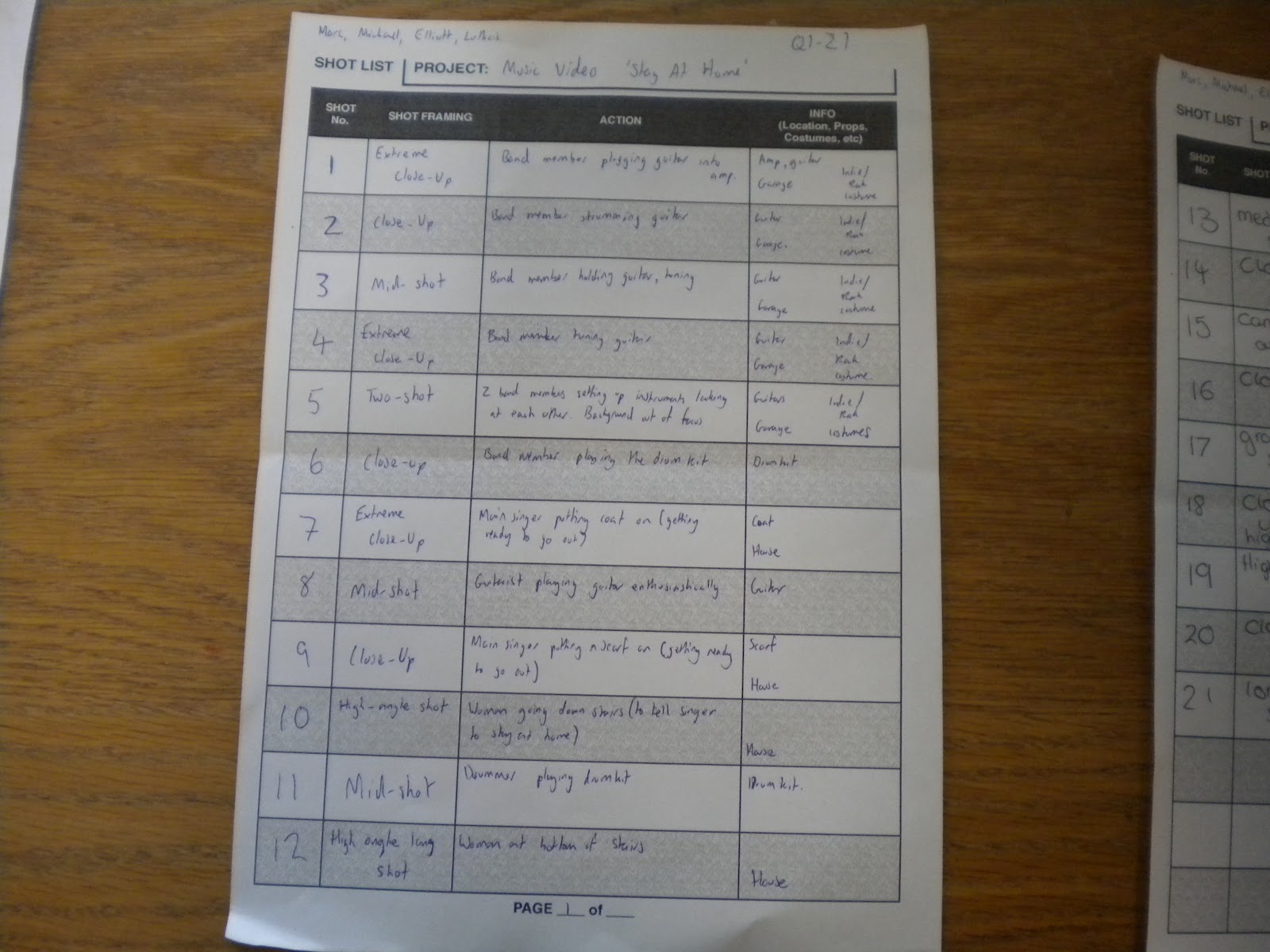
    Storyboards, Shot Lists, and Call Sheet

    Text
    This shot list shows what shots we want to utilise in our video and where. This may not be exactly what is shown in our music video but will be approximately similar.


    These shots of our storyboard are showing the basic premise and start to our music video. This again is subject to change but the basic premise is going to stay the same.


    Here we'll have more shots than shown, stressing the importance the performance of the singer at this time.


    This storyboard shows the narrative of video. Again this may not be precisely what is in the finished video but the overarching "story" of the video will be the same.


    Here we will have more shots of the band performing, making use of a lot of small, quick shots to have a more up-tempo feel to the performance making it fast paced.


    Here is our production sheet, showing some locations we'll be using, contacts for that location and who the director and cameraman are for our project.