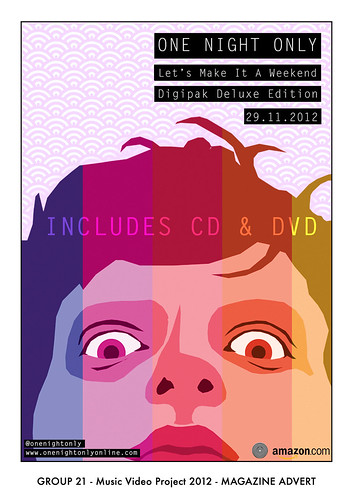
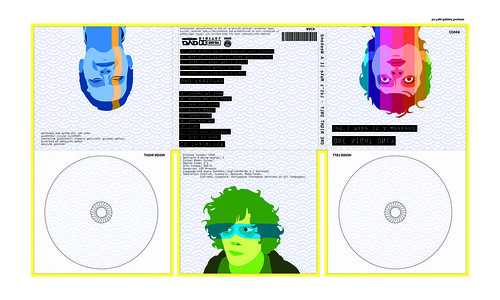
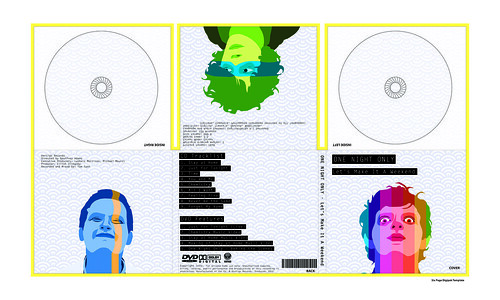
This is our final version of our magazine advert. We have put all needed information on this advert. The audience will know who's releasing the digipak, what the digipak is called, when it'll be released and where they can buy it. We have also included information on how to contact the artist.
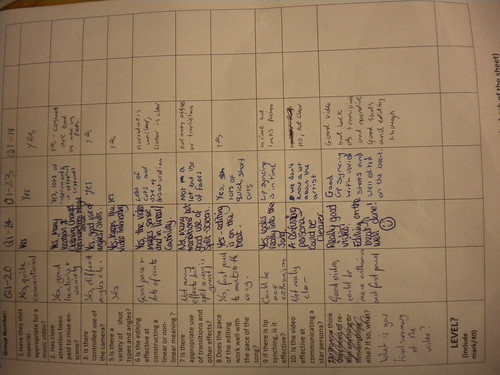
We received feedback for our final music video from all the groups in our class. When all feedback was reviewed, we spotted a number of things:
The music video definitely has appropriate content
Mise-en-scene has been payed close attention, as there were use of costumes and different lighting techniques
There was controlled use of the camera
A lot of different camera angles were used
The editing was effective of creating a linear meaning
There were a few effects and transitions included in the video
The editing worked perfectly with the pace of the song
Lip syncing was effective
Apparently the star persona is not clear
Overall, the music video was well executed
Taking this feedback into account, we believe the music video we creating is outstanding. One thing we should improve on in the future is making the star persona more clear to the audience.
After experimenting with using posterization in photoshop, we have agreed that this can create an interesting and effective cover.
We have discussed using all 3 members of the band on different sides of the Digipak, with Michael, the lead singer in our video, being on the cover.
Using this we can create a continuous feel for the digipak. Saying this though, we do feel that while minimalism is a genre convention of indie rock album covers, using just posterized faces like in our previous post may be too simplistic/minimal.
To combat this we are thinking of inserting a continuous pattern into the back ground. An example of this would be from the band Kid, You'll Move Mountains, who in both their advert for their album "Loomings" use an interesting pattern.
Here, in the advert for the album, it is used to create a wave like effect, which we like. We are thinking about using this kind of pattern, or one very similar, to give a more interesting and diverse look to our cover while maintaining an indie rock and minimalistic feel.
In the album cover, the same pattern is used to a different effect, rather than creating a wave-like effect, it acts more as a background pattern to break the monotony of the image.
Here we have an image we posterized manually of popular musician Neil Fallon of Clutch.
We have done this so we can assess the effectiveness of using posterized images for our digipak and/or magazine advert.
Here is the original picture for reference:
And this is the version we posterized, and we believe that this technique can be used effectively for our Digipak if done well:
Below you can see the two videos I reference later on.
Here It Goes Again:
This Too Shall Pass (Rube Goldberg Version):
How would you describe their star persona?
OK Go's star persona is very quirky and unique compared to other artists, because even though they produce serious songs, their videos are far from it, and are usually hard and laborious to actually produce.
What use of Goodwin's theory is made in their videos?
OK Go seem to take a very different approach on Goodwin's theories, because very few of them are implemented often. For example, the most obvious one is the relationship between visuals and lyrics, because literally in every video they've produced, the relationship is non existent.
When it comes to the relationship between the visuals and the music itself, OK Go take a very unconventional approach to it. This is evident in the video "This Too Shall Pass (Rube Goldberg Version)", because instead of doing the convention editing on the beat to link the visuals and music, they link actions to the music, even to the point where the rube goldberg mechanism itself plays a small section of the song using forks and wine glasses.
In "Here It Goes Again", you can also see that they link actions to the music, but in this case the actions are dance moves intricately timed on running machines.
How would you describe their target audience?
OK Go's videos are very much targeted towards the internet community, mainly the YouTube community.
How are they attempting to appeal to art alternative audience?
OK Go reach their audience very successfully by making their videos very unique and interesting, as an attempt to make them go viral, and with the video count of up to 15 Million on some of their videos, is obviously very effective.
How would you describe the target audience for your music video?
The target audience for our music video is very similar to OK Go's, because the genre of One Night Only is also indie alt rock. How are you attempting to target that audience?
Unlike OK Go, we can't produce a very intricate video because we lack time, and the funding. So instead we decided to appeal by making a video that related to the average listener, by having the artist leave the house to have fun in town with friends.
Task 4:
For this task, I chose the YouTube channel (and sub channels) owned by the company "Vevo", and the television channel "MTV", both of which are specifically targeted to show music, and music related media.
The difference between MTV and Vevo is the fact that MTV's main presence is only on the TV, and Vevo's main presence is on YouTube. MTV has been around for a lot longer than Vevo, which has only become popular in the last 2 years.
I don't think that MTV and Vevo would show our video, but no because it wouldn't fit, but because as an indie alt rock band's perspective, it probably wouldn't be good for the band's star persona seeing as they want to upkeep the indie alt rock image.